
Can You Get an AI to Cite You? A GEO Experiment on My Own Content
If I write something rigorous and specific, does that actually make AI systems more likely to cite it? Or does none of that matter, and citation is closer to a black box than SEO ever was? I tested 6 GEO strategies on my own benchmark article to find out.

The Question
A few months ago I published a benchmark on Google Search Grounding: I tested whether it actually prevents LLM hallucination, and found that grounded and ungrounded responses landed at similar accuracy under certain conditions, with two specific failure modes I called "zombie restaurants" and "locality drift." It was a coded, reproducible test, not a hot take, and it got real traction.
Which raised a different question: if I write something rigorous and specific, does that actually make AI systems more likely to cite it? Or does none of that matter, and citation is closer to a black box than SEO ever was?
I picked this article to test on for a simple reason: it already had everything a "before" state needs. Real findings, real numbers, a distinctive angle (nobody else is calling it the zombie restaurant problem), and an existing audience who'd read it. If GEO techniques were going to move the needle anywhere, they should move it here.
So I ran a baseline test, made a specific, documented set of changes, and I'm going to re-test and report what actually happened, including if the answer is "not much."
The Baseline
I tested five queries across three AI systems: ChatGPT, Perplexity, and Gemini.
The queries:
- What causes hallucination in Google Search Grounding for LLM apps?
- Zombie restaurant problem LLM
- Does Google Search Grounding Prevent Hallucination?
- How to reduce hallucinations in AI search grounding
- Is Gemini search grounding reliable for production apps?
For each, I recorded whether my article was cited, how accurately the response reflected my actual findings even when it wasn't cited, and what was cited instead.
Baseline Benchmark Matrix
| Query | Engine | Cited? | Accuracy |
|---|---|---|---|
| What causes hallucination in Google Search Grounding for LLM apps? | ChatGPT | No | Medium |
| What causes hallucination in Google Search Grounding for LLM apps? | Perplexity | No | High |
| What causes hallucination in Google Search Grounding for LLM apps? | Gemini | No | Medium |
| Zombie restaurant problem LLM | ChatGPT | No | High |
| Zombie restaurant problem LLM | Perplexity | No | Low |
| Zombie restaurant problem LLM | Gemini | No | Low |
| Does Google Search Grounding Prevent Hallucination? | ChatGPT | No | Medium |
| Does Google Search Grounding Prevent Hallucination? | Perplexity | No | High |
| Does Google Search Grounding Prevent Hallucination? | Gemini | No | High |
| How to reduce hallucinations in AI search grounding | ChatGPT | No | High |
| How to reduce hallucinations in AI search grounding | Perplexity | No | Medium |
| How to reduce hallucinations in AI search grounding | Gemini | No | Low |
| Is Gemini search grounding reliable for production apps? | ChatGPT | No | High |
| Is Gemini search grounding reliable for production apps? | Perplexity | No | Medium |
| Is Gemini search grounding reliable for production apps? | Gemini | No | Low |
Full notes and methodology: baseline-results.md.
The baseline result: zero citations, across all five queries, on all three engines.
That's not surprising on its own, general awareness content rarely gets cited over official documentation right out of the gate. What was more interesting was looking at why.
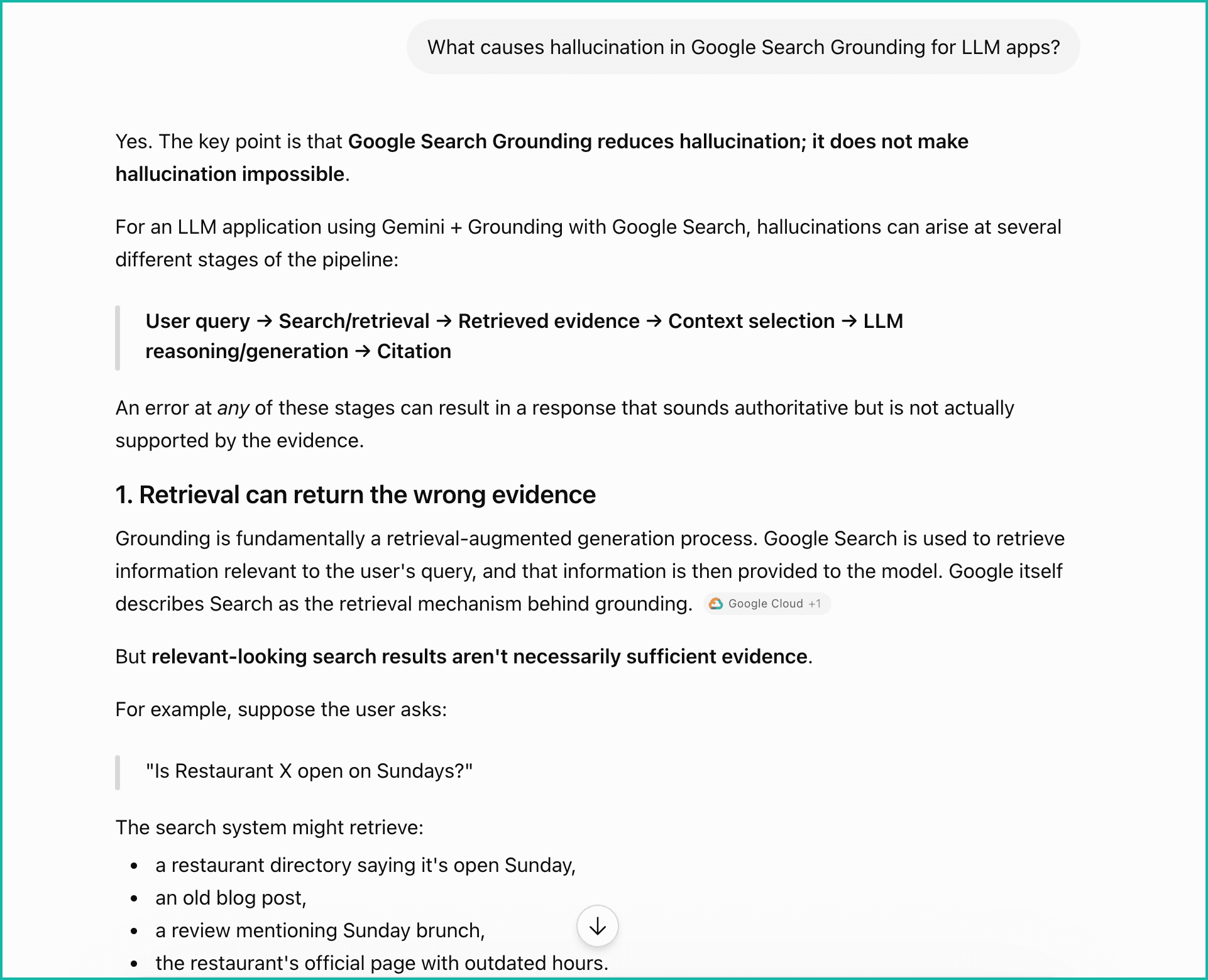
Take the first query, "What causes hallucination in Google Search Grounding for LLM apps?" ChatGPT's answer was directionally correct: it said grounding reduces but doesn't eliminate hallucination, and walked through a generic retrieval-augmented-generation pipeline.
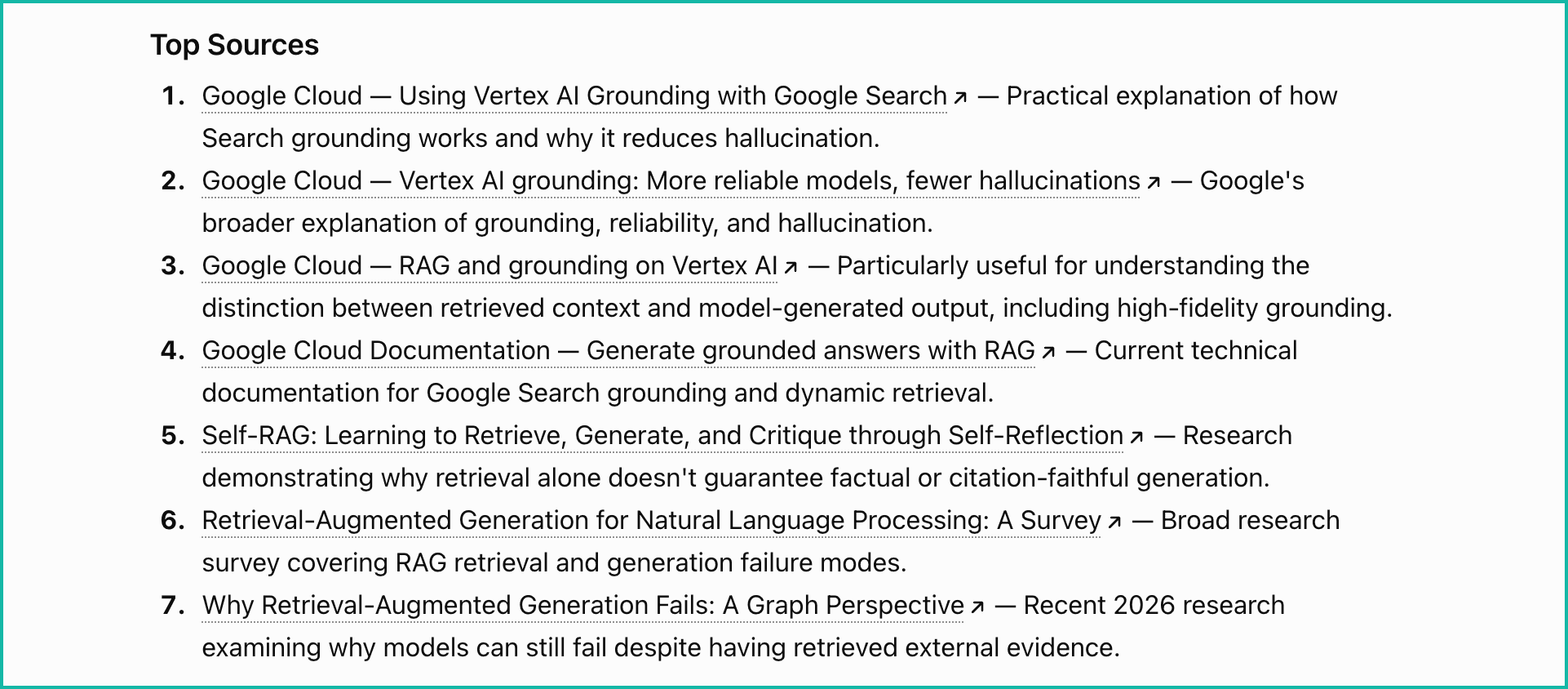
But every one of its seven listed sources was either official Google Cloud documentation or an academic paper on RAG failure modes. No practitioner testing. No real numbers. And at one point, illustrating how retrieval can go wrong, it reached for a hypothetical example: "Is Restaurant X open on Sundays?" It invented a plausible failure scenario in the exact domain my benchmark already tested empirically, because nothing in its source list had one to point to.
That's the gap this experiment is really about. It's not just "will I get cited," it's "is there a hole in what AI systems can currently cite for this question, and does my content actually fill it."
What I Changed, and Why
I made six changes, each targeting a specific mechanism in how AI systems select and extract content, not just "more SEO."
1. A Direct-Answer Block (Right After the Intro)
SEO rewarded pages that kept people reading. AI systems don't read for engagement, they read for a sentence they can lift and trust. So I added a short, dense paragraph stating the core finding in plain numbers: 30 queries, 10 cities, 73.3% accuracy, both failure modes named outright. If a model is going to summarize this article in one breath, I wanted to hand it that breath directly instead of making it infer one from three paragraphs of narrative.
2. Subheadings Rewritten as Real Questions
My original headers were narrative ("The Real Enemies: Stale Data and Suburb Blindness"). I rewrote the key ones to match how people, and models answering people, actually phrase the question ("What Causes Hallucination in Google Search Grounding for LLM Apps?"). This is the closest thing GEO has to old-fashioned keyword matching in a title tag, except now it's matching a question shape, not a search term.
3. Making Claims Self-Contained
I went through the article looking for sentences that only made sense with their paragraph attached, things like "the data proved me wrong," which means nothing on its own. I rewrote these so each carries its own subject and number. A model extracting a sentence out of context needs that sentence to still be true and complete in isolation.
4. Credibility Signals (Moved Up, Not Buried)
I added a line near the top establishing that this is a coded, reproducible benchmark, not opinion, alongside my Google Developer Expert credential and a direct link to the methodology. AI systems seem to weight specificity and verifiability heavily; "I tested this" reads very differently than "in my experience."
5. An FAQ Section Using My Exact Baseline Queries
This is the most direct lever I have. I wrote five question-and-answer pairs using the literal queries I'm testing against, with tight two-to-three-sentence answers. If I'm going to measure whether these five questions surface my content, I might as well pre-answer them explicitly.
6. A Stronger Repository Reference
Instead of a bare link, I described what's actually in the repo, the full dataset, the test harness, the raw results, right next to where it's mentioned. Models seem more willing to point to supporting evidence when it's described in the surrounding text, not just hyperlinked and left unexplained.
None of these changes touched the actual findings. Same numbers, same failure modes, same conclusions. The goal wasn't to say anything different, it was to say the same thing in a shape that's easier for a model to find, trust, and lift cleanly.
(Note: The original pre-change version is preserved in the GitHub repo commit history, alongside the full change log detailing before/after text).
What I Expect, and What I Genuinely Don't Know Yet
I expect the FAQ section and the direct-answer block to move the needle the most since they're the most literal answer to "make this extractable." I'm less sure about the subheading rewrites; they're a reasonable bet based on how these systems seem to match content to queries, but I don't have hard evidence that heading phrasing carries the same weight in GEO that title tags did in SEO.
I also don't know how long re-indexing will take, or whether these systems will index this specific page again within a timeframe I can measure cleanly. That's the honest limitation of doing this on your own small site rather than a high-traffic domain: the signal might be real and just slow to show up, or it might not show up at all, and I won't fully be able to tell the difference from one measurement.
There's also no equivalent yet of Search Console for this. I can't see why a citation happened or didn't, only whether it did. So this is a black-box test of a black box, which is a little uncomfortable to admit, but it's also honestly the most interesting part of running it.
I'll re-measure the same five queries against the same three engines in 1 to 2 weeks, and report exactly what moved, what didn't, and what surprised me, including if the honest answer is "nothing changed."
This is a live experiment. Baseline data, the full change log, and the original pre-change article are all public in the benchmark repo. I'll update this post with results once re-measurement is complete.