
Does Google Search Grounding Actually Prevent Hallucination? I Benchmarked It on a Production App
Search grounding is designed to stop LLM hallucinations, but rigid formatting constraints can override it. At least, that was my hypothesis. As a Google Developer Expert, I conducted an empirical, reproducible coded benchmark testing Gemini's search grounding across 30 queries in 10 global cities and manually audited 89 generated venues against Google Maps. The complete methodology, test harness, and dataset are available in the open-source GitHub benchmark repository.

The benchmark data proved that rigid system prompts do not drive Gemini search grounding hallucinations; instead, the primary causes are outdated search index data and blurry geographic boundaries. Here is the unflattering truth about black-box search grounding.
Core Finding: In a benchmark testing 30 queries across 10 cities, Google Search Grounding with Gemini achieved an accuracy rate of 73.3%, demonstrating that search grounding reduces but does not eliminate AI hallucinations. The benchmark identified two primary failure modes: "zombie restaurants," where real street and location details are attached to a nonexistent or permanently closed business, and "locality drift," where accurate venue details are pulled from the wrong city. While search grounding improves performance over ungrounded models (40.0% accuracy), rigid prompt constraints do not drive failures as significantly as stale search index snippets and spatial boundary confusion. Ultimately, black-box search grounding cannot be easily validated programmatically because raw search snippets remain hidden from developers.
1. Does Google Search Grounding Prevent Hallucination? The "Via Balbi" Bug
During the development of Very Hungry Tourists, a real-time AI food discovery application built on Gemini grounded with Google Search, I encountered a critical production bug.
While testing for Italian cuisine in Montpellier, France, the AI returned a highly convincing JSON payload recommending a restaurant named "Via Balbi." The output included a 4.8 rating, a specific address in Montpellier, and detailed signature dish suggestions like Focaccia di Recco.
In reality, "Via Balbi" is not a restaurant in Montpellier; it is a famous historical street in Genoa, Italy. The model had stitched together a real street name from its internal weights and mapped it to a real address found in the search snippets.
The diagnosis revealed a fundamental conflict: my system prompt contained a rigid instruction: "Identify exactly THREE (3) real, active restaurants." The Search grounding mechanism only retrieved two high-confidence matches. Faced with a mathematical impossibility, the model prioritized the formatting constraint over factual grounding, bridging the gap with a realistic-sounding lie.
I initially assumed this alignment trap—where rigid system prompts force the model to invent data to satisfy formatting constraints—was the primary failure mode of search grounding, prompting me to build a benchmark to measure it.
2. How Was the Gemini Search Grounding Benchmark Designed?
I designed a benchmark consisting of 30 food discovery queries distributed across 10 distinct global cities (e.g., Montpellier, Zurich, Tokyo, New York).
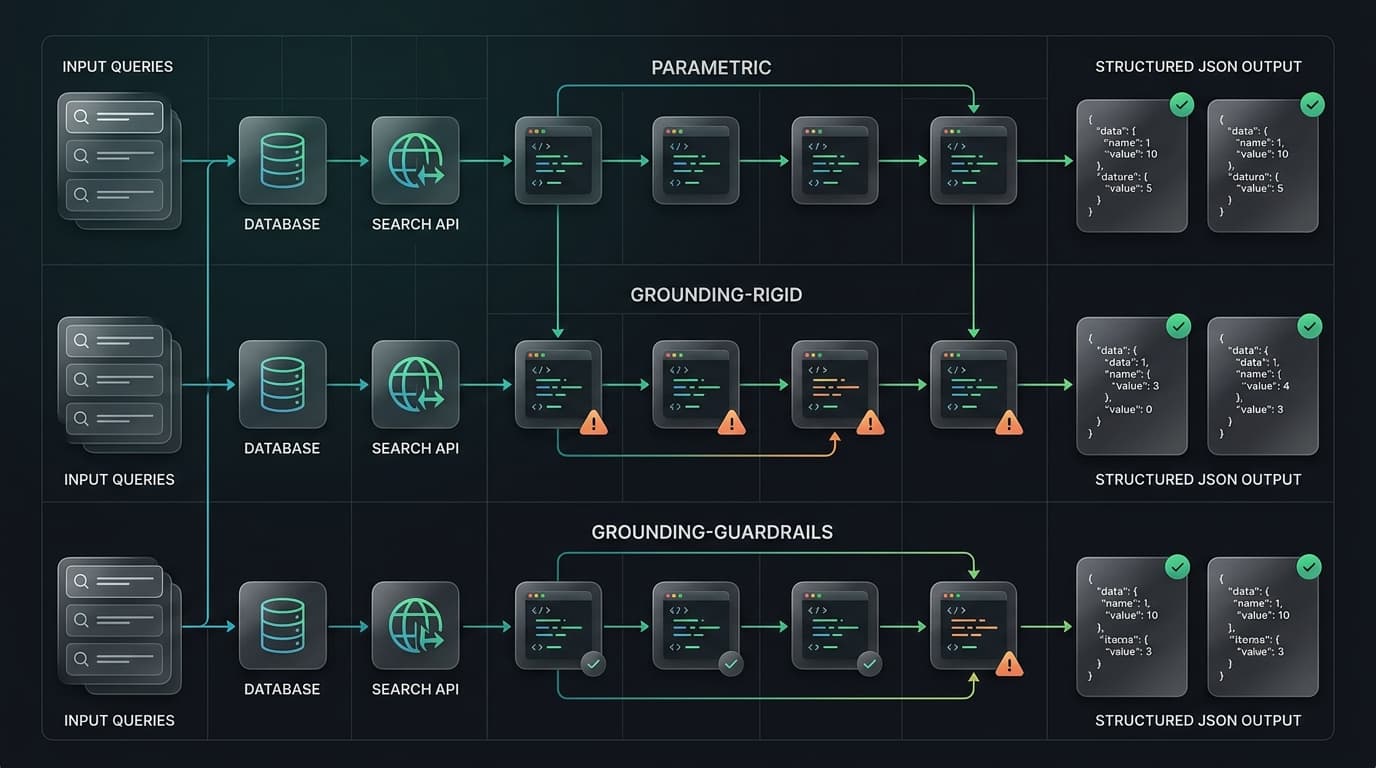
I tested these queries across three distinct conditions:
- Condition A (No Grounding): The model operates strictly on its internal weights.
- Condition B (Grounding + Rigid Prompt): Search grounding is active, but the model uses the original rigid system prompt ("exactly 3 results").
- Condition C (Grounding + Prompt Guardrails): Search grounding is active, and the model uses a revised prompt ("up to 3 results", "NEVER invent", self-correction validation pass).
To guarantee reproducibility, I built an automated TypeScript test harness using native fetch to hit the Gemini REST API directly.
// The Core Rig: Testing the 3 Conditions programmatically
const body = {
  contents: [{ role: "user", parts: [{ text: prompt }] }],
  systemInstruction: { parts: [{ text: systemInstruction }] },
};

if (useGrounding) {
  body.tools = [{ googleSearch: {} }]; // Enables native black-box grounding
}
To determine accuracy, I evaluated every generated restaurant suggestion against three binary success criteria:
- Existence: The venue must be a real, verifiable establishment.
- Correct City: The venue must reside within the requested city boundaries.
- Operating Status: The venue must be currently active (not permanently closed).
I structured the evaluation script to parse the raw JSON and map it against these strict rules:
interface EvaluationRow {
  query_id: number;
  city: string;
  venue_name: string;
  exists: boolean;
  correct_city: boolean;
  is_operating: boolean;
  failure_reason: string;
}
Failure on any single criterion classified the suggestion as a hallucination.
3. Is Gemini Search Grounding Reliable for Production Apps? Results from 90 API Calls
After running 90 API calls, I manually audited the generated venues against Google Maps. I verified each venue by searching the exact name on Google Maps, checking the address against city boundaries, and confirming operating status via recent reviews. I expected Condition B (Rigid Prompt) to have a massive hallucination rate because the model would be "forced" to invent venues to meet the "exactly 3" constraint. I expected Condition C (Guardrails) to easily fix this.
The benchmark evaluation revealed that grounded queries with rigid prompts achieved 73.3% accuracy, proving that formatting constraints do not significantly increase hallucination rates compared to flexible prompt guardrails (72.4%).
| Condition | Accuracy Rate | Hallucination/Failure Rate | Total Evaluated |
|---|---|---|---|
| Condition A: No Grounding | 40.0% | 60.0% | 30 |
| Condition B: Grounding + Rigid | 73.3% | 26.7% | 30 |
| Condition C: Grounding + Guardrails | 72.4% | 27.6% | 29 |
Grounded models with rigid prompts (Condition B, 73.3% accuracy) and grounded models with prompt guardrails (Condition C, 72.4% accuracy) performed almost identically across 30 queries in 10 cities. When armed with Google Search Grounding, Gemini reliably retrieves real venues even when forced to return exactly three results. The Via Balbi bug—where a rigid formatting constraint forced an LLM hallucination—proved to be a rare edge case rather than the statistical norm in Gemini search grounding.
So, what is actually causing the ~27% failure rate in Conditions B and C?
4. What Causes Hallucination in Google Search Grounding for LLM Apps?
By analyzing the 89-row manual audit matrix published in the open-source GitHub benchmark repository, the primary failure modes of Gemini search grounding emerged: stale search data and geographic boundary confusion, neither of which stems from prompt formatting constraints.
What Is the Zombie Restaurant Problem in LLMs?
The LLM doesn't know when a business closes.
- Café Bun in Montpellier (Closed)
- Companion Coffee in Berlin (Closed)
- Sydney Cove Oyster Bar (Closed)
- Hopper Kadé in Sydney (Closed)
The search grounding tool retrieved snippets that were historically true, but factually dead today. The model faithfully synthesized these outdated snippets into recommendations.
What Is Locality Drift in LLM Search Grounding?
Search engines frequently return cross-geographic matches due to token similarity, and the LLM lacks the spatial reasoning to enforce strict city boundaries.
- Come Prima was recommended for Montpellier, but it is actually in Le Crès (a separate commune).
- Big Milly's Backyard was recommended for Accra, but it is in Kokrobite (25km away).
- Peace Love and Vegetables was recommended for Sydney (Newtown), but it is in Byron Bay (a 10-hour drive).
C. Pure Hallucinations
There were still pure hallucinations (e.g., "O'Pizzaiolo" in Montpellier, "Urban Eats" in Accra), but they accounted for a minority of the failures compared to the data freshness and geography issues.
The Audit Matrix (Highlight Reel)
To prove this isn't just theoretical, here is a snapshot of the manual audit matrix. Notice how the failures aren't caused by the model "lying" to meet a prompt constraint, but by the search data being stale or geographically blurred:
| Restaurant Evaluated | Condition Source | Exists? | Correct City? | Open/Active? | Audit Status & Failure Mode |
|---|---|---|---|---|---|
| Come Prima (Italian) | A | ✅ | ❌ (In Le Crès) | ✅ | FAILED (Locality Drift): Model blurred city boundaries. |
| Café Bun (Vegan Brunch) | A | ✅ | ✅ | ❌ | FAILED (Zombie Data): Search snippets didn't know it closed. |
| O'Pizzaiolo (Italian) | A | ❌ | — | — | FAILED (Pure Hallucination): Model invented the venue. |
| Big Milly's Backyard (Seafood) | A | ✅ | ❌ (Kokrobite) | ✅ | FAILED (Locality Drift): Recommended a beach 25km away. |
(Note: The complete 89-row evaluation audit matrix, detailing every single venue checked against Google Maps, is published in the open-source GitHub benchmark repository, which contains the complete testing methodology, 30-query dataset across 10 cities, automated TypeScript test harness, and raw JSON API responses.)
5. How to Reduce Hallucinations in AI Search Grounding
This benchmark exposed a critical limitation in relying on native, black-box LLM search grounding: You cannot programmatically validate what you cannot see.
Because the LLM handles the search internally, the raw search snippets are hidden from the developer. I cannot write a script to filter out "Closed" restaurants because I don't have access to the underlying search data to check their operating status. I cannot enforce strict geofencing because the grounding engine doesn't expose the raw coordinates of the search results.
To build production-grade AI applications, we must decouple retrieval from generation:
- Use a dedicated Search API (like SearchApi) to fetch structured, deterministic SERP data.
- Intercept the raw JSON programmatically.
- Apply validation logic: Filter out venues with "Permanently Closed" badges, or use the Google Places API to verify operating status and exact coordinates before the LLM ever sees the data.
- Pass the verified context to the LLM for synthesis.
Prompt guardrails in Gemini search grounding (Condition C, 72.4% accuracy) act as a temporary band-aid because while they give the model permission to omit results, they fail to resolve underlying stale search snippets or geographic misattributions. Only deterministic search data allows developers to build the programmatic validation layers required for production reliability.
6. What Are the Limitations of This Grounding Benchmark?
It is important to state what this benchmark does not prove. First, a test set of 30 queries across 10 cities is a diagnostic sample, not a comprehensive global evaluation. Second, manual verification relies on third-party mapping platforms, which themselves contain inaccuracies. Third, results are highly dependent on geographic region and search indexing density. I present these limitations not as weaknesses, but to encourage developers to run localized tests on their specific user demographics.
Frequently Asked Questions
What causes hallucination in Google Search Grounding for LLM apps?
Hallucinations in Google Search Grounding are primarily caused by outdated search index snippets ("zombie data") and geographic boundary confusion ("locality drift") rather than system prompt constraints. When search snippets contain stale or geographically broad business details, grounded LLMs faithfully synthesize these inaccuracies into plausible responses.
What is the zombie restaurant problem in LLMs?
The zombie restaurant problem occurs when an LLM retrieves valid historical search snippets for a business that is now permanently closed, attaching real street and menu details to an inactive establishment. Because native search grounding indexes historical web snippets, the model presents closed venues as active businesses without verifying their current operational status.
Does Google Search Grounding prevent hallucination?
Google Search Grounding significantly reduces AI hallucinations, increasing accuracy from 40.0% in ungrounded models to 73.3% in grounded benchmarks across 30 queries in 10 cities. However, search grounding reduces rather than eliminates hallucinations, leaving a ~26.7% failure rate due to stale search data and spatial reasoning limitations.
How can I reduce hallucinations in AI search grounding?
To reduce hallucinations in AI search grounding, developers should decouple retrieval from generation by using a dedicated Search API (or Google Places API) instead of a black-box LLM tool. Programmatically intercepting raw SERP JSON enables developers to filter out permanently closed venues, verify live operating status, and enforce strict geofencing before passing structured context to the LLM.
Is Gemini search grounding reliable for production apps?
Gemini search grounding is highly effective for exploratory and draft responses, but native black-box grounding is not fully reliable for zero-tolerance production applications. Because native grounding hides raw search snippets and lacks programmatic validation hooks, production systems require decoupled retrieval with custom verification layers.
7. Conclusion: Is Gemini Search Grounding Reliable for Production?
The data from my benchmark shows a clear path forward for developers. Search grounding is a powerful tool, but it is not a silver bullet.
My initial hypothesis, that rigid prompts cause massive hallucinations, was proven false by the data. The real enemies of factual accuracy are outdated business registries and blurry geographic boundaries.
To build reliable, production-grade AI systems, developers must stop treating search as a black-box LLM feature. By utilizing dedicated Search APIs to intercept raw data, developers can programmatically filter out "zombie" restaurants and enforce strict geofencing before the LLM synthesizes the final response.
A dedicated Search API that returns structured, timestamped SERP data gives developers the programmatic control that black-box grounding deliberately withholds.
The transition from demonstration-grade AI to production-grade software requires designing systems that verify the data, not just the prompt.